Are you ready for the adventure of a lifetime? A safari in Africa is high on the bucket list of many travelers and we understand that better than anyone! Seeing all those beautiful wild animals in their natural environment is an unforgettable experience. But how do you ensure that you capture that experience in beautiful wildlife photos? We share our 5 golden tips with you to take the most beautiful photos during your safari. From the right camera choice to the patience to capture the perfect moment, we will take you through it step by step. So read on and discover how you can turn your safari adventure into the most beautiful images!
TIP #1: BRING A CAMERA.. DUH!
Yup, you read that right: a camera. Needless to say, right? Well.. Not always, because we still see people taking pictures with a smartphone every now and then during a safari. Which is possible of course. But do you take the most beautiful pictures with it? Nah.. At most some nice pictures to quickly share on your social media, or maybe for yourself to look back at that lion you’ve really spotted! In most cases, the quality of a smartphone picture will never match the quality of a picture taken with a decent camera. Especially if you want to enlarge or print the picture, you will be disappointed by the quality if it was taken with a smartphone. The zoom of a smartphone is digital, so the picture will look blurry and/or grainy when you enlarge it. That would be a shame! After all, you want to show the most beautiful pictures when you come home after your beautiful Africa trip?!
There are, of course, countless cameras on the market. It is difficult to just advise which camera you should take with you. Of course we all want that super luxurious system,- or SLR camera with a huge telephoto lens, which you see National Geographic photographers carrying with them around on TV. But A: That costs lots and lots of money, so start buying a lottery ticket 😉 B: You need quite a bit of experience for it, otherwise you can’t do anything with it and C: you’ll have to do some serious heavy lifting.
Of course there is something for everyone. Are you a novice photographer with little experience (yet)? Then visit a good photo shop and let yourself be well informed by experts. You can often try out different cameras. There is a good chance that a compact camera with a good zoom function is more than adequate for taking beautiful sharp photos during your safari!
Yes, of course you can immediately spend thousands of dollars on it and buy an SLR camera with the whole nine yards. But if you lack experience and don’t know how to properly use it, believe me, you will probably get really better and sharper pictures with the cheaper compact camera. Don’t make it too complicated for yourself and start with a camera suitable for a novice photographer. Maybe you can consider taking a course before you go travel so you can at least learn the basics. There are also endless fun and educational photography tutorials on YouTube where you can also gain basic knowledge (and more!). Read up on it, practice with the different options on the camera and you will soon find out if it is ‘your thing’. If so, then that ‘National Geographic’ camera will come to you eventually!
For the more advanced photographer, it goes without saying that a somewhat more extensive camera with more options is a more logical choice. Where one photographer opts for a good and comprehensive compact/bridge camera, the other opts for the SLR or system camera with interchangeable lenses. For safari, a lens with a decent zoom is desirable in any case, if you also want to capture animals that you can sometimes only admire from a distance – think of birds as well.


TIP #2: LIGHT, LIGHT AND.. MORE LIGHT!
Yet another ‘slam dunk’, but still an important tip: never skip the golden hour when you are on safari. Do you want to make a poster-worthy picture that has written Africa all over it? Then you will either have to get up very early to be ready with your camera during sunrise or have to wait until the end of the afternoon for sunset. It is precisely at these times of the day that you get the best exposed pictures, although it is of course always a matter of taste. Because the sun is low you get the ‘golden light’ and everything looks like it is gold plated. And let’s be honest for a moment; When you think of Africa, don’t you immediately think of those spectacular sunsets with the fiery red, pink and orange skies? If you’re up for it, wait for the golden hour and your pictures are guaranteed to get that wow factor! There are also photographers who love the blue hour: the hour before sunrise and the hour after sunset. We are talking about twilight, when the sky is a bit bluer and cooler in hue. This can also provide a nice atmospheric picture.
Having that said, you can of course also take beautiful pictures during the day. Sometimes it is a challenge to get the lighting right, especially when the sun shines super bright and there is not a cloud to be found in the sky. But with the right settings, maybe some post-processing, you can still get some great shots.
Even without light you can take spectacular shots, because in Africa the night sky is drop dead gorgeous! The stars so bright, so clear, not to mention the milky way that shows itself with ease. Feel free to search the internet for galaxy photography and be inspired, that is really an art and certainly a trade in its own right!


TIP #3: A LITTLE TO THE LEFT... YES! PERFECT!
COMPOSITION & BACKGROUND
Taking random pictures of anything that breathes and moves. Well yes, that can be a strategy, but whether that also produces the most beautiful pictures is questionable. Of course we all secretly want to make that breathtaking National Geographic worthy wildlife picture. But make no mistake: you don’t just take a picture like that easily! A number of factors are very important and if you take that into account, you will soon notice that you take better pictures.
Let’s start with the composition. Ensuring the right composition really means that you place or position the desired subject of your picture in a good, interesting way in the image you are capturing. For example, we are all familiar with the classic school photo in which the pupil is neatly displayed in the middle of the photo. You may capture your subject at different positions within the frame. The rule that is often applied is the classic ‘rule of thirds’. You can see this as an imaginary grid consisting of 4 lines that you place over the picture as a kind of ‘tic-tac-toe’ game board. In some cameras you can set this grid digitally and see it through the viewfinder or on the LCD screen while you shoot. This grid has 4 intersections. When you capture your subject on one of the lines or – better yet – on one of the 4 intersections, the viewer’s attention is automatically drawn to the subject the best and often the strongest.
That’s not to say that you can’t take a great photo ‘outside the lines’, if you think about it and have a plan then just go for it! A surprising composition that has been carefully thought through can be at least as interesting and beautiful.
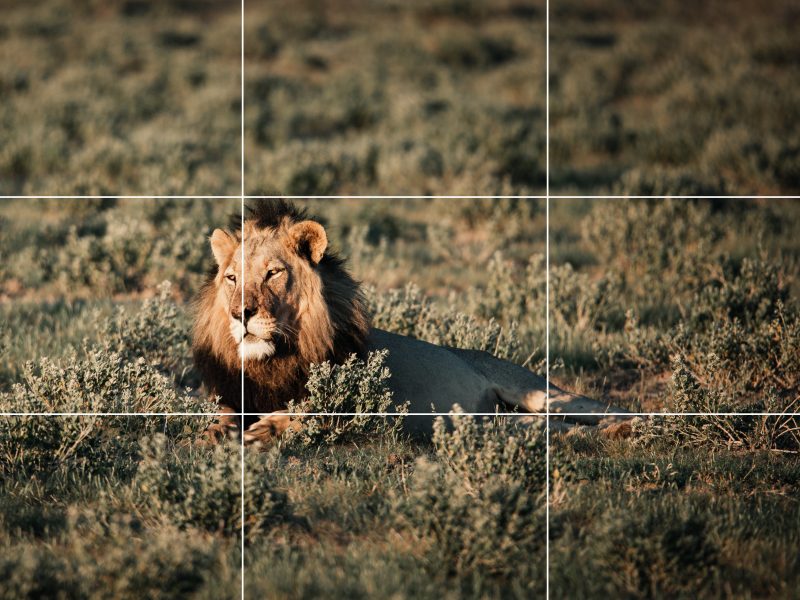

In addition to the composition of the photo, the background (or foreground) is of course very important and also determines how your photo will look. When you are on safari, you can deal with different environments. Sometimes the environments help to make a beautiful picture, but sometimes the environment can certainly work against your picture. When you want to photograph a lion lying in the dense bushes, it is quite difficult to take a nice picture. A cluttered and busy background will distract from the lion and it often just isn’t as pretty. Surely you still want to photograph that lion, because hey, maybe you’ve been looking for 3 days! In addition, you never know whether you will encounter another lion and certainly not on that beautiful desired open savanna. So yes, definitely take that picture! But maybe in the case of the dense bushes you can choose to take some nice close-ups if your zoom function is sufficient enough. In that case, you might still get a spectacular portrait photo of the lion without the distracting background.
When you continue on your way and you end up in an environment with more open plains, this often provides beautiful foregrounds or backgrounds. That is when it really pays to involve the environment in your subject, because let’s face it, a photo of giraffes walking across the ‘golden’ savanna is something to drool over, right? So always try to look carefully at the subject you want to photograph, in combination with the environment.
We often leave the camera aside when we see an animal in an environment that is not very attractive for a picture. This way you can occasionally enjoy your safari a bit more relaxed and grab the camera at that moment you have such a wow-setting again!
The only rule that applies at all times of course: ALWAYS take a photo when you spot a special animal and especially when it is at the top of your bucket list! 😉


TIP #4: PATIENT IS A VIRTUE..
The most beautiful and sometimes the most annoying thing about safari is that nothing can be predicted. Especially when it comes to spotting and photographing wild animals. Sometimes you can drive around for hours and come across little or nothing except for a few impalas and some zebras. You can also unexpectedly drive along an open plain where you see so many wild animals that you almost can’t decide where to look. If you really want to take that one perfect wildlife photo, then it will require some commitment on your part. You can choose to set out to look for that one beautiful animal in that beautiful setting. You then actually go after your subject.
Another tactic might be to let the subject come to you. You can look for a beautiful (photo) setting, for example a place where animals come to drink, a beautiful open plain with that huge beautiful baobab tree, or that beautiful savanna with that hill in the background. Park your car, and wait…… If you are lucky enough animals just pass by, or they come to drink, your patience may be greatly rewarded and you can take a nice photo in the setting you have chosen. Choose the strategy that works for you! Sometimes you have to make a plan to get the best shot and sometimes you’re just really lucky and everything comes together at the right time at the right place.

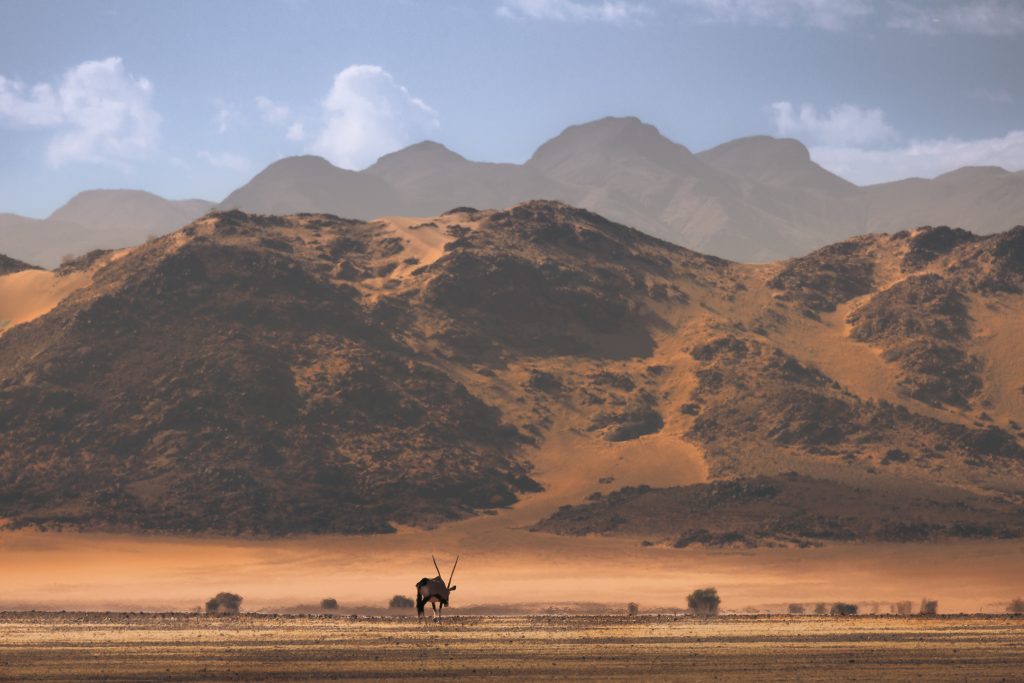
“This beautiful oryx was walking along the road in Namibia, far away from the famous red dunes. We both saw our dream photo in front of us: the oryx with the dunes in the background. Actually, we were on our way to Dodevlei and wanted to get there on time before the sun was too high. Still, we decided to keep waiting and dared to take our dream photo. We hoped that the oryx would walk towards the dunes. After more than 20 minutes of waiting, our patience was richly rewarded and we were able to take this photo!”
TIP #5: GOOD PREPARATION IS HALF THE WORK!
Of course it also sounds so obvious, but it is really useful to reflect on it. Okay, the preparation. First of all, don’t forget your camera. Ok, a little bland, but at least I’ve said it. It is also useful if you have enough memory cards with you because -trust me- on safari you take so many pictures that 1 memory card is often not enough. Make sure that the memory cards work properly and that you have enough space on them. In some cameras you can place 2 memory cards, make sure to use this. In addition, you can of course also choose to take an external hard drive with you to store your pictures on in the meantime so that you create space for new pictures. As for batteries, make sure they are sufficiently charged before you go out and a spare battery is always a joy to have with you.
Well, you have your camera with you, batteries charged and memory card in it, you look out of your window and suddenly you see a cheetah running by, chasing a springbok!! Five minutes later, when you’ve removed your lens cap, adjusted your camera settings and are ready to go, the cheetah is already snoring under the bushes 5 kilometers further down the road. Wow, that really sucks! So.. It is really very useful if you have removed the lens cap beforehand and/or have taken your camera out of the case, have checked whether your lens is clean, have the camera on or standby and have already set the settings correctly stand for the circumstances at that time. A good option can also be that you set the camera to ‘burst mode’ during safari. If you hold down the shutter button in this mode, your camera will take several pictures per second. Most cameras do have a similar function. This way you can photograph animals in action well and quickly and you have a better chance of a successful shot! Furthermore, it can be useful – certainly with the heavier cameras with large lenses – if you have a bean bag hanging over your door so you can quickly stabilize your camera by placing it on top.
I hope the above tips help you on your way to taking the most beautiful wildlife pictures. Furthermore, the most important thing is that you enjoy it! If you practice a lot and photograph a lot, that dream shot will come by itself. Persistence wins.. And please, don’t forget to put your camera aside every now and then and enjoy all the beautiful things you see during your safari..