#1 A country with an interesting history
Namibia: the land of the brave. Ok, a few facts about the country before we dive into history. It’s the second most sparsely populated country in the world with a population of about 2.5 million.The country borders 4 countries: Angola, Zambia, Botswana and South Africa and is located along the Atlantic Ocean.
Even before the beginning of the modern era, Namibia was populated by the San (also known as the Bushmen). They were hunters, gatherers and they lived a nomadic existence. After some time, other population groups followed such as the Ovambo and Kavango (farmers), Nama, Khoikhoi and the Herero (shepherds). The Herero arrived in Namibia from the northwest and settled in Kaokoland in northern Namibia. Some tribes moved further south in the course of the 19th century, towards Damaraland. We now know those who stayed behind as the Himba. During the colonial German occupation of the region, a large part of the Herero people and Nama people under ‘Lothar von Trotha’ were killed during the Namibian Genocide.
At the end of the 15th century, the first Europeans set foot on land, but it was not until the middle of the 19th century that they became interested in the country. In September 1883 Lüderitz took possession of the country, under the protection of the German navy. In April 1884 it was officially placed under the protection of the German Empire, establishing the first part of the colony of German Southwest Africa. Among other things, the discovery of diamonds caused an enormous growth of white German inhabitants (fortune seekers).
After the natives rose up and wanted to make a stand against German power, this led to what is now known as the ‘forgotten genocide of the 20th century’. There was a massacre of German colonial troops in Namibia between 1904 and 1908. Tens of thousands of people were murdered, as much as eighty percent of the Herero and Nama minorities were expelled or murdered.
Elections to the Constitutional Assembly were held in November 1989. This Constitutional Assembly established the Constitution and on March 21, 1990, the country became independent and was given a new name: Namibia.
Although today the German and Namibian governments are negotiating compensation, the families of the victims are furious. They don’t feel heard and do not feel part of this process. The large farms in Namibia are to this day in the hands of the descendants of the German settlers, while the traditional Herero farmers languish landless with their livestock.
They don't talk to us. We call that the second genocide. That is psychological warfare.
Veteruke Kandoruzu, councilor on behalf of the Herero
A country with a painful history where the German influences are still very visible. German street names, German restaurants, German architecture, etc. Many people also speak German, but in addition to the many languages within Namibia, the main language is English.


#2 Breathtaking landscapes
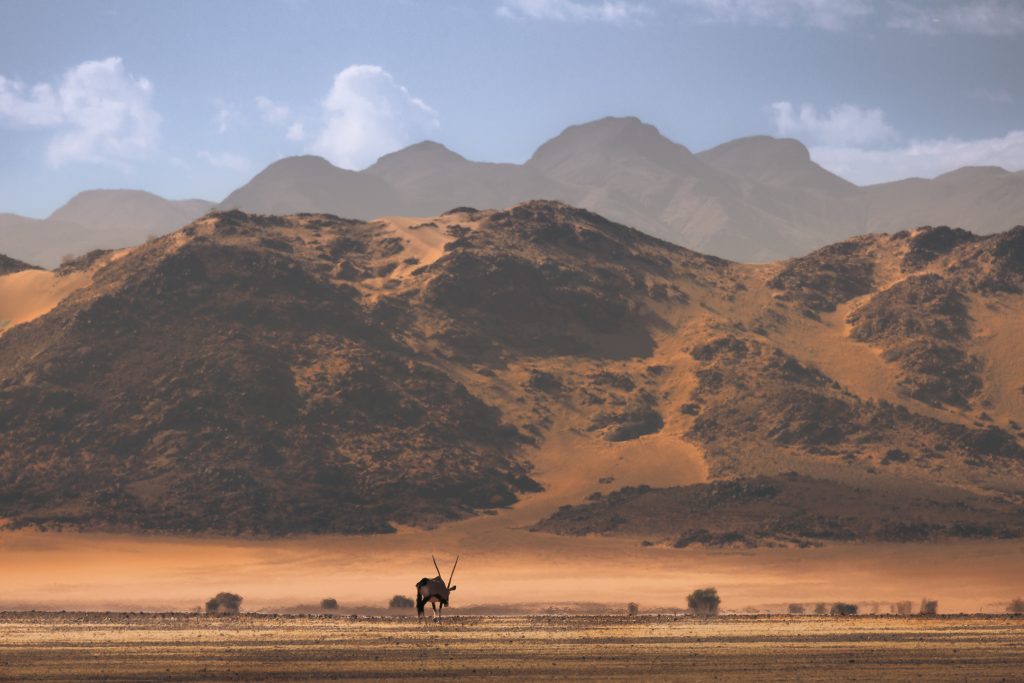
What is the first image that comes to your mind when you think of Namibia? I’m willing to bet! One of the most impressive ‘images’ of Namibia are of course those of the world famous red sand dunes of Sossusvlei. With the well-known white clay plain where you can find the famous skeletons of the dead trees: Dodevlei. A surreal image that you can almost believe is fake. But it’s not, it’s an insanely beautiful place where it feels like you’re on another planet. This place is part of the Namib-Naukluft National Park in Namibia. The Namib Desert is the oldest in the world, about 55 million years old! The desert stretches for about 150 kilometers along the Atlantic coast.
Further north you can travel along the famous Skeleton coast, where you can find many old shipwrecks along the coastline. But also inland you will be amazed when you travel through Namibia. When we told our friends and family that we would visit Namibia, we got a lot of reactions like,, huh, but isn’t that just dry and arid desert?”. No way! Namibia is incredibly varied, with a lot of biodiversity and while driving the landscape changes without you noticing it, really very special! From the famous red dunes, up to the ocean, up to the green Caprivi strip with beautiful nature reserves in between, the Kalahari desert, impressive wildlife parks and the second largest canyon in the world: Fish River Canyon. The views are indescribably beautiful and nowhere in the world do you feel so small and if you love that: go and experience it!
For landscape lovers, Namibia is really a country that you must visit at least once in a lifetime. This of course also applies to photography enthusiasts, because Namibia is a feast for the eye and for the lens! Never before have we visited such a photogenic country.

#3 Wildlife inside and outside the parks!
Namibia is rich in wildlife, both inside and outside the parks. Of course there is the famous ‘Big 5’, but there is also the largest seal colony in Africa with sometimes more than 200,000 seals! In addition, you also have white sharks, whales, dolphins. Bird lovers can also indulge themselves with more than 650 bird species. And you would hardly believe it, but even in the sweltering and dry deserts there is wildlife to be found: snakes, lizards, oryx and perhaps most special: lions, elephants and black rhinos! What? Yes, it’s true! In Namibia live the last desert lions that have been able to adapt to the relentless aridity of the Namib desert and the Skeleton coast. It is estimated that about 80 remain in the area today. Their habitat is huge so the chance that you will actually spot them is very small, but sometimes you are lucky! We haven’t spotted them yet, so we have another good reason to go back.
The same goes for the desert elephants: also something so special! These elephants are also adapted to survive in the rugged desert areas, they are more slender than the rest of the elephant family, they have longer legs to make it easier to cover enormous distances in search of water.
You will also find a relatively large concentration of black rhinos in Namibia. They are often protected day and night against poachers. It is a hard struggle to keep them alive and every now and then the poachers still manage to slaughter a rhino. Still, Namibia is doing very well when it comes to protecting the black rhino and is one of the few countries where numbers are actually growing! In Damaraland you have a reasonable chance – possibly with the help of a guide – to spot desert elephants or black rhinos.
In the game parks such as the famous Etosha NP you are guaranteed to encounter many animals and birds. In addition, there are some other national parks where you can spot wildlife such as Waterberg Plateau, Kaudum wildlife park and Bwabwata national park in the Caprivi strip. There are also a number of private game reserves that you can also visit, such as Erindi Private Game Reserve.
What we found especially fantastic is that you can spot so many wild animals during your road trip. We saw beautiful large birds of prey on the way such as vultures, martial eagles and various eagles. But also countless oryx, giraffes and even the rather rare mountain zebras. So look around you when you’re on the road and keep your binoculars close, because I guarantee you will be blown away! Don’t forget to keep an eye on the road of course..

#4 The most beautiful place in the sun, all year round
You have to be able to withstand a bit of heat, well, a bit..? Temperatures in Namibia can reach up to 38 degrees in the summer (during our winter). The north and east of Namibia have a warm steppe climate. Most of the country has a desert climate, which means it can be very dry and hot during the day and very cold at night with temperatures reaching freezing point. In the winter months it is therefore advisable to take some extra blankets with you when you go camping and warm clothes for the evenings and mornings. Sitting around a warm campfire in the evening is of course always a brilliant idea!
If you are looking for a destination where the sun is almost always guaranteed, then Namibia is the right place for you. Even in the winter months (our summer) the temperature almost never drops below 20 degrees, perfect right? Namibia does have a rainy season: most of the rain falls between December and March. These are often short and heavy rain and thunderstorms. After that, the sun often shines again so it certainly does not have to stand in the way of your trip. However, after rain showers you have to pay attention to the roads that can sometimes be more difficult to pass and you also have to be careful with parking your car in a dry riverbed. During the rainy season, these dry riverbeds in Namibia can sometimes change violently swirling bodies of water after a heavy rain shower! Better safe than sorry!
All in all, Namibia is a destination that you can travel well all year round. In general, June through October are the best months for spotting wildlife. It is a lot drier then, so you have a better chance of spotting game around the waterholes.
We ourselves think March/early April is a great time to visit Namibia, it is just before the high season, which they also call ‘shoulder season’. It was super quiet, we hardly encountered any tourists, because it is the end of the rainy season, we saw a lot of birds, which we – as real birdnerds – thought was very nice. Because sometimes heavy short showers fell, it was still beautifully green in many places and we were often treated to the most spectacular skies! And, not unimportantly, the prices are also a lot lower. You will certainly notice this in the rental prices of your 4×4 and those of the accommodations. Very warm during the day and very pleasant in terms of temperature at night, fresh enough to sleep well and certainly not cold, perfect for us!

#5 Get in the car and go! Ideal self-drive destination
The title says it all, get in the car and go. Namibia is the country par excellence to explore by yourself with your 4×4 car. I specifically mention ‘4×4 car’, because you generally need that to be able to discover Namibia. In addition to excellent asphalt roads, you will also find many gravel roads and to have a 4×4 in those conditions is often very pleasant. You then have more floor space, it is also much more comfortable to drive. With a 4×4 you can also make more speed on the gravel roads, sometimes up to about 80 km per hour. I would definitely NOT advise going much harder, this entails unnecessary risks because of the sometimes unpredictable road conditions. But you also want to be able to avoid crossing game in time.
The roads in Namibia can be divided into the following categories:
Type B: The asphalted national roads that often lead to the larger cities and border crossings. The roads are often in good condition and easy to travel.
Type C: The gravel roads. You will find these roads in different conditions, sometimes good, sometimes not so good, but in general passable by all cars.
Type D: The real 4×4 tracks/trails. These roads are only accessible with a 4×4 vehicle and can lead you through riverbeds, for example. Some 4×4 experience can sometimes be nice to avoid unpleasant surprises during your trip. With the advanced 4×4 trails it can sometimes be wise to drive with at least 2 cars so that you can help each other if one gets stuck.
Furthermore, it is always wise to always refuel when you come across a gas station on the way. Sometimes you can only find the next gas station 400 km away and if you are unlucky, they are out of fuel. That can just happen, so avoid an empty tank and always fill your car where you can. Of course you can also choose to fill and take some extra jerry cans with you.
And did I mention that you have to drive on the left in Namibia? You probably already knew that. Now it’s not that complicated in Namibia as it is very quiet on most roads, but it is good to always stay alert when you encounter other traffic if you are used to driving on the right side. Many people choose to rent an automatic transmission so they don’t have to shift left, of course that’s optional. Our experience is that this costs a lot more money, while we were actually used to shifting left literally within 10 minutes. All the more money left to spend on nice things in Namibia!
Avoid driving at night due to unpredictable road conditions and wildlife crossing. Animals often become more active during twilight as temperatures drop.
The nice thing about a self drive is that you can of course determine your own pace and route, you can stop at the most beautiful places along the way to have some lunch or simply to enjoy the breathtaking views that the country offers. The good news is that getting lost is almost impossible when your navigation indicates “turn right after 400 kilometers”. Only in Namibia!

#6 Camping country!
Namibia camping country! Yes, you can also book many beautiful hotels, B&Bs and lodges, varying in many price categories; from backpack rates to prices ‘for the rich and famous’. But Namibia is above all a fantastic camping destination. In fact, it’s the first country that made me love camping. I can assure you, that took quite a bit. I was that type of person who always shouted “camping is true suffering!”. Yep, I am guilty! But after my camping experience in Namibia, I don’t really want anything else anymore. Camping spots with the most indescribable views, with really no one else around you. The sunrises and sunsets, sitting around your campfire and enjoying the stars, as far as I’m concerned, the most expensive hotel can’t compete with that. You can’t feel closer to nature than when you are camping, sleeping in your rooftop tent.
In Namibia you can rent cars from almost all 4×4 rental companies with all camping items included. Cooking utensils, bedding, cutlery, table, chairs, gas bottles, cool box/freezer, etc. You will not be short of anything. You can of course also choose a ground tent if you are less mobile, for example. You can camp wild in Namibia. There are rules, so read carefully if you are planning this. We consciously chose to camp in paid places in order to support the tourism sector.
There are many beautiful camping spots to book in Namibia, sometimes completely back to basic and sometimes with all the luxurious amenities you could wish for, something for everyone! You can also camp in game parks such as Etosha, it is a bit busier there so don’t expect an exclusive place where you are alone. Because many tourists opt for a camping trip in Namibia, it can sometimes pay off to book all your most desired / most popular camping spots at least six months in advance, because they fill up quickly, since the places are sometimes limited. For example, if you want to visit Sossusvlei during sunrise, be as early as possible to book your camping spot in the national park. If you don’t stay in the park you can only enter the park an hour later than those who stay in the park, so you miss the sunrise and that would of course be a shame!

#7 Peace and space...
Do you also love to escape the hectic pace and crowds during your holiday? You can do that in Namibia! As mentioned earlier, Namibia is the second most sparsely populated country in the world. As soon as you leave the cities you will find yourself in an oasis of calm. You can sometimes drive around for hours or even most of the day without encountering people. That sounds almost impossible, right? Namibia is not a country with mass tourism. Of course, you also meet other tourists, but you can’t compare this with destinations like Spain, New York or Greece. The country is so big, so vast, so you have so much space that you don’t have to get in each other’s way.
Truly a destination where you can relax. Overlooking the desert with a delicious glass of wine in your hands you will find the ultimate peace and relaxation. Driving along the rugged Atlantic coastline where high waves reach the land, you’ll truly feel small and insignificant. Personally, I find that an addictive feeling and that made me instantly fall in love with the country. The peace, the space, the slowing down. It’s a beautiful country, what else can I say?! Are you looking for peace and space? Go and visit beautiful Namibia!

#8 Don't worry, be happy!
Namibia is a safe destination, so as the title suggests: don’t worry, be happy. There is little crime against tourists. If it happens at all, it is often in the cities like Windhoek or Swakopmund. There, as in any larger city, you have to be alert and sensible. Do not flaunt expensive jewelry or cameras and behave respectfully towards the local population and prefer not to walk (alone) in the dark if it is not necessary. Also, don’t just visit a township on your own. Do not leave your valuables in sight in your car and, if possible, park your car in guarded parking spaces.
Safety is often something you can control yourself. In Namibia you sometimes travel long distances on roads that you are usually not used to. That requires quite a bit of alertness and energy. So make sure you make enough stops to relax and stretch your legs. Most accidents in Namibia often happen because people drive for too long and become overtired and, for example, fly out of bend on gravel roads. Likewise with speeding. Again, do not drive after dark due to wildlife and livestock crossing between sunrise and sunset.
#9 When the sun goes down, the stars will rise…
Namibia has arguably the most beautiful sunrises and sunsets imaginable. The vast expanses of (desert) landscapes make it an impressive spectacle that you just can’t get enough of. Actually, I personally think it is almost a kind of crime if you are in Namibia and you skip sunrise or sunrise because you want to sleep in, for example. Then you miss one of the most beautiful moments of the day, impossible as far as I’m concerned!
When the sun is setting, leave whatever you are doing and watch it.”
Mehmet Murat Ildan
And we haven’t even talked about the starry sky in Namibia. That alone is reason enough to travel to this country. You can probably imagine that there is hardly any light pollution in such a sparsely populated country. In fact, when you camp in Namibia, sometimes the starry sky is the only light source you have. Nowhere in the world have I been able to see such a breathtaking starry sky as in Namibia. Sitting around the campfire, looking at the crystal-clear stars and milky way above me, looking back to another great day in this magical country is perhaps the best feeling I’ve ever experienced.

#10 There is so much to do!
Besides road tripping, camping and going on safari, is there anything else to do in Namibia? Well, I can assure you there is. There are a lot of activities that you can undertake – organized or not! You can go for beautiful hiking trails throughout the country, varying from a few hours to multi-day trips. You can start this in Windhoek and the surrounding area, but also around Spitzkoppe where you can admire the ancient rock paintings of the San. You can also hike beautifully at Fish River canyon or Waterberg Plateau. Enough choice! A way to make your Namibia trip a little more luxurious is to do a flight over Sossusvlei / Namib desert, or how about a hot air balloon ride? That too is possible! Ok, it will cost you a penny, but it will be worth it..
You can also experience organized 4×4 tours in the sand dunes along the coast, driving straight down from the high sand dunes, or along the Atlantic coastline. How about sandboarding the dunes at Swakopmund? Definitely a must for the ‘thrill seekers’! Also fun to do with (or without) kids: together with a ranger in search of the desert’s ‘Small 5’ in the sand dunes, or with a boat tour in search of whales and dolphins while the pelicans and seals jump on the boat to come and collect some fresh fish. You can go on a walking tour with the San people to learn more about life in the bush.
In short, there are a lot of fun activities that you can undertake in Namibia, organized or otherwise, for young and old! For the adventurers and for nature lovers. This is just a small list, because there is so much more to do. At least you won’t be bored -not even for a second- during your Namibia trip!
Are you considering traveling to Namibia? Join our facebook group ‘Travelling Namibia & Botswana’! You can ask for tips/advice or be inspired by other travellers, we already have more than 30,000 members, so it’s the ideal place to prepare your Namibia trip!